Passport photo rules
Passport Photo Hair Rules: What you need to know for acceptance
You usually do not need a special haircut for a passport photo. What matters is a clear likeness, visible eyes and the face visibility required by the issuing country. Keep your usual hairstyle where possible, move obstructing strands and check the actual photograph before submitting.
By Passport Photo · Published · 5 min read
Sources reviewed
Editorial standards and commercial disclosure · Report a correction
The main rule: keep your face clearly visible
Start with the passport authority’s photo instructions. UK guidance requires open, visible eyes, no hair in front of them and nothing covering the face. Canadian guidance accepts hair up or down, provided it stays off the face so the facial edges are visible.
This is not a requirement to straighten curls, cut long hair or adopt a particular parting. Our practical advice is to adjust only what obstructs your face or causes a lighting problem. A recognisable likeness matters more than a polished hairstyle.
Official hair guidance in five countries
Do not treat one country’s rule as universal. In particular, ear visibility and the space around your hairstyle need checking against the issuing authority’s instructions.
| Passport | What the official guidance says |
|---|---|
| United Kingdom | No hair in front of the eyes; eyes open and visible; nothing covering the face. |
| Canada | Hair may be up or down, but must be off the face so facial edges are visible. |
| United States | The photo examples reject hair blocking part of the face. Keep the full face visible. |
| France | Hair must not cover the face. A fringe is acceptable if it does not cover the eyes; ears must be uncovered. |
| New Zealand | Centre the head with a clear gap around the sides and top; include shoulders and upper chest. |
Can I keep my fringe or bangs?
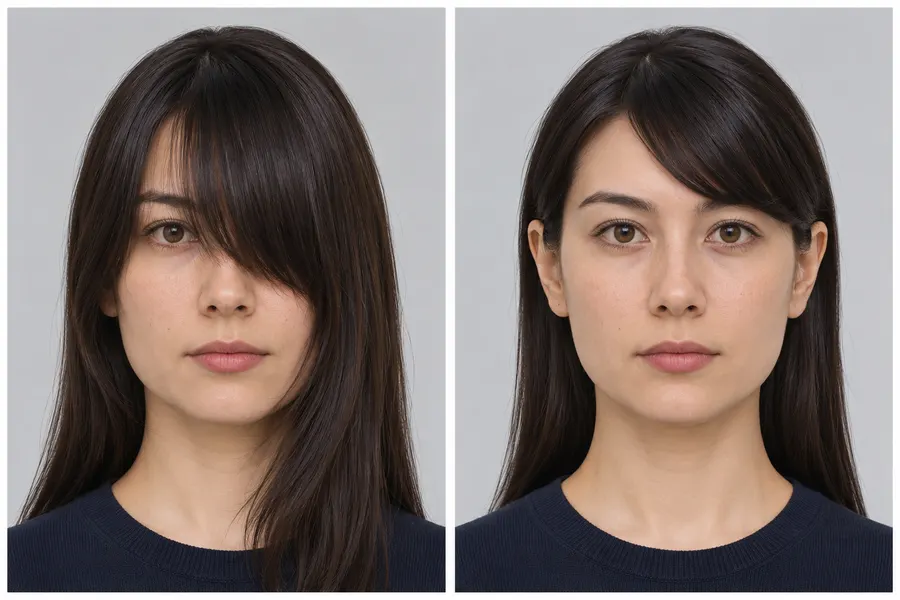
A fringe is not automatically a problem. France explicitly allows one when it does not cover the eyes. UK guidance also says hair must not be in front of the eyes.
For the session, our practical suggestion is to brush the fringe aside or secure it discreetly if strands fall into your eyes. Check both eyes in the captured photo: a strand that looks harmless in the mirror can cross an eye when you face the lens.
Keep the required straight-on pose. Do not tip your head backwards or look upwards to see beneath a fringe; move the hair instead.
Long hair, curls, braids, locs and protective styles
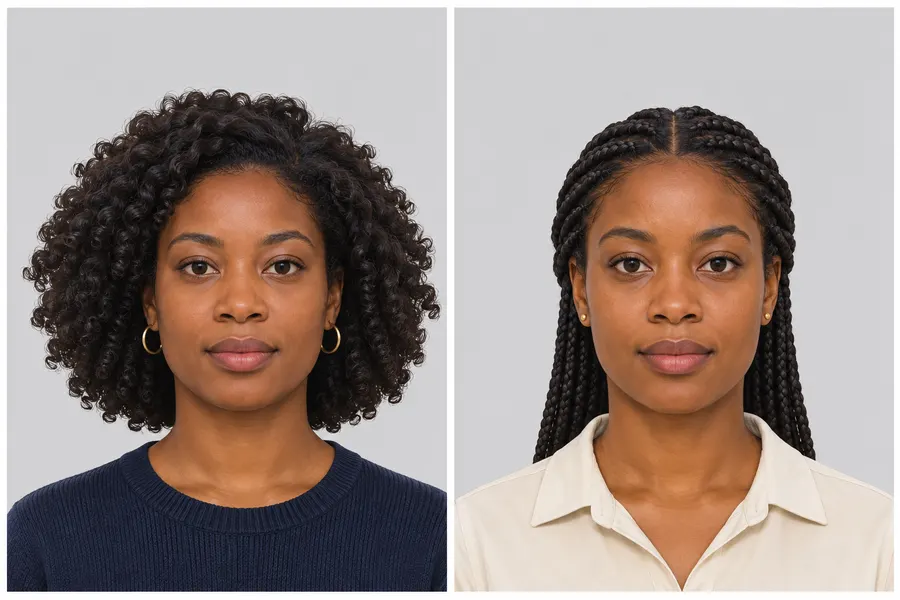
For long or voluminous hair, focus on the outline of the face and correct framing. The same practical approach works for curls, braids, locs and protective styles: arrange the hair so it does not fall over the eyes or conceal the facial features your authority needs to see.
You can try bringing hair behind the shoulders or tying it back loosely if that makes the face clearer. These are optional styling suggestions, not a universal requirement to wear a ponytail or change hair texture.
Leave enough room around the hairstyle when taking the original photo. New Zealand explicitly requires a gap around the top and sides of the head. Do not shrink the face excessively or stretch the image just to fit a tall bun or a wide hairstyle into the frame.
Do my ears have to show?
Check the country rather than assuming both ears must always be visible. France’s passport photo guidance explicitly says the ears must be uncovered. Canada focuses on keeping the facial edges visible, while the UK page focuses on visible eyes and an unobstructed face.
If your authority requires uncovered ears, arrange the hair before capture and inspect both sides of the image. Do not digitally remove hair to reveal an ear or invent an obscured feature.
Hair accessories and head coverings
Avoid assuming that decorative headwear is treated like an ordinary hairstyle. France’s guidance excludes hats, scarves and headbands in its standard photo rules. New Zealand permits head coverings only for religious or medical reasons, with the face fully visible.
UK guidance also permits religious or medical head coverings. US passport guidance requires supporting statements for religious or medical head coverings and says the full face must remain visible without shadows or obstruction.
Our practical suggestion is to use only the small, unobtrusive fastenings needed to keep hair clear, and verify any visible accessory against your authority’s instructions. For a medical or religious accommodation, follow that country’s process before submitting.
Prevent hair shadows and framing problems
Hair can leave your eyes uncovered but still cast a dark patch across the forehead or cheeks. Use soft, even light, then look for shadows beneath the fringe and beside the face. Move obstructing strands or change the light before taking another photograph.
Check the hair against the background too. Avoid overexposing pale hair until it disappears or underexposing dark hair until the edges lose detail. Keep a natural appearance and the required contrast.
These are practical capture tips. The final photo must also meet the country’s head-size, background, pose and image-quality rules. A tidy hairstyle cannot compensate for a blurry or badly framed image.
Can I edit flyaways or change my hair digitally?
Do not use retouching to repair a non-compliant hairstyle. Canada rejects altered passport photos and specifically lists changing hair colour among appearance edits. New Zealand prohibits filters and AI tools that modify how you look.
Retake the photograph after arranging your hair. Avoid generating a different hairline, removing strands across the face or digitally revealing hidden facial features. Our service uses AI generation, so processed output should not be assumed suitable where original, unaltered photos are required.
Before submitting your photo
Review the full-size image as well as its small preview. Following these checks can reduce avoidable problems, but acceptance remains with the passport authority.
- Both eyes are clearly visible, with no strands crossing them.
- The face and its edges meet the issuing country’s visibility rules.
- Ears are uncovered where specifically required.
- Hair and accessories cast no unsuitable facial shadows.
- The hairstyle fits the required framing without making the face too small.
- Any head covering follows the applicable religious or medical instructions.
- The image is a faithful likeness and has not been retouched to fix the hair.
Sources and research method
Reviewed 23 November 2026 using official passport photo guidance from the UK, Canada, US, France and New Zealand. French instructions are summarised in English from Service Public. Styling and lighting suggestions are practical editorial advice, not a government-approved hairstyle list. Check the current rules for your exact passport application.
More from the blog
- Passport Photo Quality: what you need to know? →
- Biometric Passports: What is it?, Key Features and How to Apply? →
- Glasses in Passport Photos: Rules and Tips for a Successful Application →
- Shadows in Passport Photos: Tips for a Successful Application →
- How Do I Take a Passport Photo at Home with a Smartphone? →
- Style and Makeup for Visa and Passport Photos: Can I? If so, How? →
- US Visa Photo: What Are the Requirements? →
- Schengen Visa Photo: What Are the Requirements? →
- Passport Photos at Staples: Costs, Convenience and Comparison →
- Passport Photo Background Requirements by Country (White, Off-White, or Gray) →
- How to Take a Passport Photo with iPhone - a 2026 Guide →
- Common Reasons why USCIS Photo Rejected (And How to Fix Them) →
- COVA Upload Errors for China Visa Photo (And How to Fix Them) →
- India e-Visa Photo Rejection Reasons →
- DV Lottery Photo Requirements as of 2026 - a Complete Guide →
- Employment Authorization Document (EAD) Photo Guide and requirements →
- I-485 Photo Requirements for Adjustment of Status as of 2026 →
- N-400 Citizenship Photo Requirements - Things to know →
- How to Get Infant Passport Photo Right →
- AI Passport Photo - How AI Truly Helps →
- How to Convert Any Photo to a Passport Size Photo Online →
- How to Resize a Photo to Passport Size: Sizes, Methods & Common Mistakes →
- Infant & Toddler Passport Photo Guide →
- Baby Visa Photo Requirements - specific to countries →
- 10 reasons Why Baby Passport Photos are hard and Get Rejected →
- Passport Photo Rejection Rates by Country →
- Vietnam e-Visa Photo Requirements (as of Nov 2026) →
- Common reasons why Schengen Visa photo gets rejected - How to fix them? →
- US Passport Photo rules - can you edit US Passport Photo? →
- What to Wear for Passport Photo →
- Can You Smile in a Passport Photo? →
- How to Print Passport Photos at Walgreens →
- How to Print Same-Day Photos at CVS: Almost for Free →
- Best Passport Photo Apps 2026: 6 Compared →